
The True Cost of CMS Overhead
UK Market Research 2025: What organisations actually spend just keeping their CMS alive
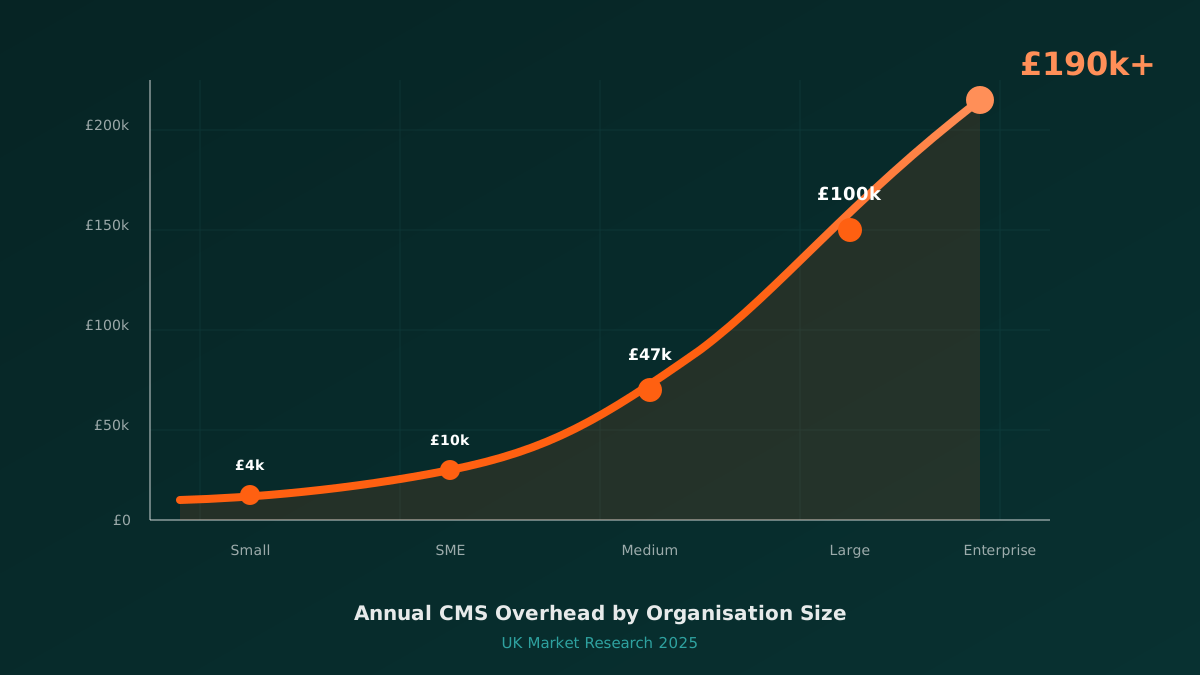
This companion research piece to Ditch the CMS provides market-backed estimates of annual CMS-only overhead for UK organisations.
The punchline: for many mid–large teams, CMS overhead alone sits in the same range as a fully on-demand design and engineering subscription.
We count only costs that exist because there's a CMS in the mix. Core design work, content creation, hosting, domains and analytics are excluded – you'd pay those regardless.
1. What we're actually counting
We include:
- CMS-specific build and rebuild effort: Installing, configuring, content modelling, templates, modules, plugins, migrations and re-platforming cycles (amortised over 4 years)
- Security patching and maintenance: Keeping CMS core, themes and plugins updated, plus maintenance retainers
- User and permission administration: Setting up users, roles, workflows and approvals inside the CMS
- Onboarding and training: Teaching editors the system, re-training on upgrades or re-platforms
- CMS licences: For proprietary enterprise CMSs and paid SaaS/headless tools
We exclude:
- Core design work and general development you'd do anyway
- Content creation and editorial work
- Hosting, domains and infrastructure
- Analytics and monitoring tools
Where formal benchmarks don't exist, we make conservative assumptions and cite them clearly.
2. How much do CMS builds actually cost?
Recent UK pricing guides for WordPress and CMS-based builds:
Authentic Style, Media Village and Tekrevol (2025) place most UK WordPress sites in this range, with freelancers typically charging £500–£5,000 and agencies £5,000–£50,000+ for complex custom sites.
Enterprise scale
For large enterprises, Abbacus Technologies (2025) advises budgeting $50,000–$500,000+ (≈£40,000–£400,000+) for CMS initiatives including licensing, integrations and custom development.
A substantial chunk of each project is driven by CMS choice:
- Modelling and configuring content types
- Building templates/components to match CMS constraints
- Implementing plugins and extensions
- Migrating content into or between CMSs
3. Ongoing maintenance and patching
Once a CMS is live, you're on the hook for continuous updates and fixes.
UK maintenance pricing
Sources: Fit Design (2025), Business Quote, Alliance Agency, SWSweb
WordPress-specific maintenance packages
Popular UK providers cluster around:
- Alliance Agency's WordPress care plans: £75, £130 and £245/month tiers
- Standard provider range: £49–£250/month for security, updates and support
Why this matters: The plugin ecosystem that makes CMSs attractive also makes them fragile.
Recent example: The W3 Total Cache WordPress plugin (1 million+ installs) had a critical (9.0/10) command-injection vulnerability. Around one-third of known installs remained unpatched weeks after the fix.
— TechRadar
In a non-CMS, component-driven stack with fewer moving parts, there's simply less to patch.
4. Licence fees: the hidden line item
For open-source CMSs like WordPress, the "licence" is effectively free – but support, premium plugins and specialised hosting often turn into a de facto licence layer.
Proprietary and headless licences
Sources: cmsMinds (2025), Emizen Tech
Headless SaaS platforms
- Contentful: paid plans starting around £240/month (~$300/month) with custom-priced enterprise tiers
- Typical Strapi enterprise setup: estimated $3,588/year licensing + ~$5,000/year developer maintenance
For mid-sized and large organisations, five–six figure annual licence costs are normal before a single piece of content is created.
5. People costs: user management and training
There aren't great public benchmarks for "average CMS training hours per editor per year", but we can triangulate using UK day rates:
Sources: h10marketing.co.uk, Checkatrade
Conservative training estimate
- A couple of days of initial training per editor
- An admin spending a few days per year on user/role management
- Retraining when the CMS changes or you re-platform
Even this modest programme quickly adds up to thousands of pounds per year in people-time – costs that disappear in an on-demand, developer- and AI-mediated model.
6. CMS-only overhead by business size
These are deliberately conservative and based on UK-oriented pricing where possible. Many organisations will sit at or above the upper bounds, especially with multiple sites or regions.
Small businesses
1 site, simple marketing/brochure, 1–3 editors
- CMS build/rebuild overhead (£8k–£20k every 4 years): £2,000–£5,000/year
- Maintenance & security (£120–£300/month): £1,440–£3,600/year
- Training & admin (2–4 days/year at ~£350/day): £700–£1,400/year
Estimated CMS-only overhead: £4,000–£10,000/year
👉 Even a small business that "just has a WordPress site" is often spending £4k–£10k per year purely on CMS overhead.
Medium businesses
1–3 brands, multi-region/multi-site, 5–15 editors
- CMS build/rebuild overhead (£30k–£90k every 4 years): £7,500–£22,500/year
- Maintenance & security (£400–£900/month): £4,800–£10,800/year
- Training & admin (4–8 days/year at ~£400–£450/day): £1,600–£3,600/year
- Licences (mid-market SaaS/headless): £3,600–£20,000/year
Estimated CMS-only overhead: £13,900–£46,900/year
👉 For a typical mid-sized organisation, £20k–£50k+ per year purely on CMS overhead is very common once you include licences.
Large / enterprise
Multi-site, multi-brand, integrations, 20+ editors
- CMS build/rebuild overhead (£120k–£300k every 4 years): £30,000–£75,000/year
- Licences (proprietary/enterprise CMSs): £15,000–£80,000+/year
- Maintenance & security (£1,200–£2,000+/month): £14,400–£24,000/year
- Training & admin (10–20 days/year at ~£450–£500/day): £4,500–£10,000/year
Estimated CMS-only overhead: £63,900–£189,000+/year
👉 For enterprise, £65k–£190k+ per year on CMS overhead alone is entirely normal – and many complex global stacks will exceed the upper bound.
- Opportunity cost of slower publishing because people are fighting the CMS
- Brand damage and technical debt from rigid templates and plugin bloat
- Cost of multi-CMS sprawl when different teams adopt their own platforms
Those impacts belong in the strategic narrative; this piece is just about the cash.
7. How this compares to on-demand subscriptions
Our on-demand service tiers (per year):
The comparison
Small businesses: £4k–£10k/year CMS overhead
A meaningful chunk of a subscription year. This spend isn't buying any strategic or creative output.
Medium organisations: £14k–£47k/year (often £20k–£50k+)
Roughly ¼–½ of full service; often similar to a full year of build-only. You're probably burning £20–50k each year just to keep your CMS stack alive – before any content, campaigns or experiments.
Large/enterprise: £65k–£190k+/year
Typically ≥ full-service and often approaching 2×. Your CMS licences, rebuilds, patching and training already cost more than a full-service on-demand design and build team. You're paying enterprise money to stand still.
- For small businesses: CMS overhead doesn't on its own cover a full subscription – but it still represents £4–10k/year that isn't buying any strategic or creative output.
- For medium organisations: "You're probably burning £20–50k each year just to keep your CMS stack alive – before any content, campaigns or experiments."
- For large/enterprise teams: "Your CMS licences, rebuilds, patching and training already cost more than a full-service on-demand design and build team. You're paying enterprise money to stand still."
8. How to use this research
This article is designed to sit alongside Ditch the CMS as the quantitative appendix:
In sales and advisory conversations:
- Use the size-tier ranges as ballparks to reframe budget discussions
- Help clients see that the line item called "CMS" is actually a cluster of recurring costs that can be reallocated
In marketing content:
- Visualise the three tiers as a simple chart: "What you spend just keeping your CMS alive vs. what a full on-demand design + build subscription costs"
In strategy:
- Continuously update these ranges as more public benchmarks appear
- Note that even with conservative 2025 data, the conclusion is clear
The cost of simply maintaining a CMS stack is often equivalent to, or greater than, the cost of having an expert, on-demand team build and evolve your digital experience for you.
In other words: the CMS isn't just a technical choice. It's a large, predictable, and often unjustified drain on your annual budget – one that your post-CMS, on-demand model is explicitly designed to remove.
9. Sources and methodology
This research draws on 2025 UK market data from:
- Authentic Style: UK WordPress pricing guides
- Tekrevol (2025): UK website pricing research
- Media Village (2025): SME WordPress build pricing
- H10 Marketing (2025): Freelancer and agency pricing
- Abbacus Technologies (2025): Enterprise CMS budget guidance
- Fit Design (2025): UK web maintenance pricing
- Business Quote: Maintenance cost ranges
- Alliance Agency: WordPress care plan tiers
- SWSweb: Maintenance package pricing
- TechRadar: W3 Total Cache vulnerability reporting
- cmsMinds (2025): Enterprise CMS licensing
- Emizen Tech: AEM and Sitecore pricing guides
- Wise: Contentful pricing analysis
- Monetizely: Strapi cost analysis
- Checkatrade: UK day rate benchmarks
All figures are conservative estimates. Actual costs often exceed these ranges, particularly for multi-site, multi-region deployments.
Stop paying CMS overhead
Let's talk about how an on-demand model can give you better results for less than you're spending just to keep your CMS alive.
Book a consultation